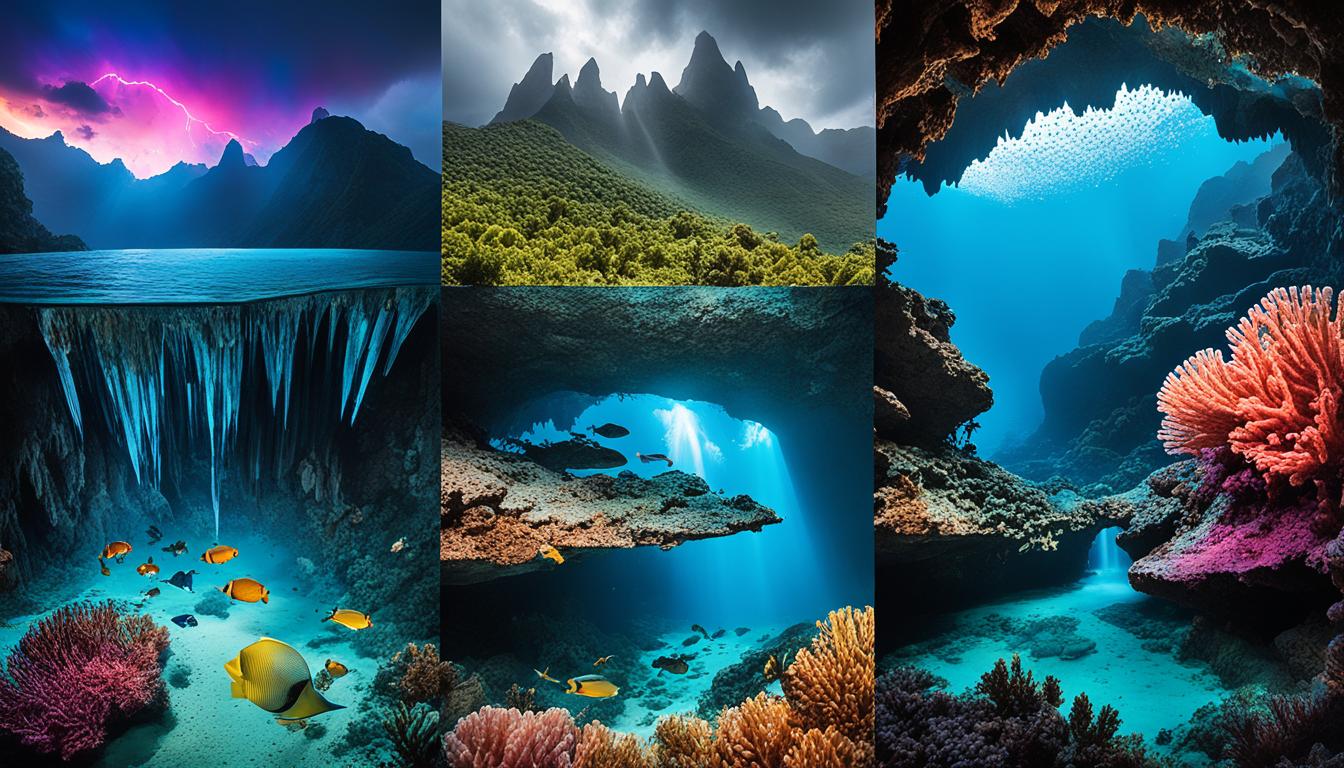
Nature is full of wonders that amaze us all. From tall trees to the Northern Lights, our planet is a marvel. This article shares 10 incredible facts about nature that will amaze you.
Get ready to explore nature’s secrets. You’ll see things that seem impossible and extraordinary. Learn about the power and beauty of our planet and its amazing stories.
Unveiling Nature’s Wonders: Fun Facts Galore
Get ready to be amazed by a collection of fascinating nature facts! Our planet is full of incredible wonders. We’ll share some of the most interesting and surprising ones from nature.
Did you know the biggest living thing isn’t a whale or an elephant? It’s a fungus! The Armillaria ostoyae, or “Honey Fungus,” covers over 2,200 acres in Oregon. It’s a single organism that’s been alive for more than 2,400 years.
Some butterflies can see ultraviolet light, which humans can’t. This lets them find their way and talk to other butterflies in ways we can’t see. It shows how diverse and adaptable nature is.
The world has towering redwoods and the stunning aurora borealis. These fun facts help us appreciate the beauty and complexity around us every day.
The Breathtaking Diversity of Life
Our planet is a wondrous tapestry, full of amazing life. From lush rainforests to dry deserts, Earth’s diversity is captivating. Let’s explore the incredible ways species adapt to their environments.
Exploring Earth’s Incredible Biodiversity
Life on Earth is truly amazing. Imagine the tall redwoods and colorful coral reefs. Our planet is home to countless species, each playing a key role in nature’s balance.
Marveling at the Unique Adaptations of Species
Species adaptations are truly remarkable. Take the camel’s ability to live in harsh deserts or the chameleon’s color-changing skills. These strategies show how life adapts to survive in different places. They prove the power of evolution and life’s resilience.
Ancient Giants: The Towering Redwoods
In the quiet forests of the western United States, a natural wonder stands tall. The ancient redwood trees are among the oldest and largest living things on Earth. They amaze everyone who sees them. Redwoods show how nature can be strong and adaptable.

These trees can grow over 300 feet tall. Their trunks are huge, some over 25 feet wide. Some of these trees are more than 2,000 years old. They have survived many challenges, like storms and fire, thanks to their thick bark and roots.
The redwood forest is a marvel of nature, a living history of our planet. Walking among these giants fills you with awe and respect. These trees, older than human history, remind us of nature’s power and resilience.
The Majestic Aurora Borealis
The aurora borealis, or northern lights, is a stunning natural light show. It’s a beautiful sight that shows the amazing beauty of our planet. The colors in the sky are a true wonder.
Nature’s Celestial Light Show
The aurora borealis is a breathtaking light show in the sky. It happens when particles from the sun meet the Earth’s magnetic field. This creates a light show with colors like green, purple, blue, and red.
Seeing the aurora borealis is a dream for many. It can only be seen near the Earth’s magnetic poles. Places like Alaska, Northern Canada, and Scandinavia offer amazing views of this light show.
The science behind the aurora borealis is fascinating. The charged particles come from the sun during solar flares. They move towards the Earth, guided by its magnetic field. Finally, they hit gases in the upper atmosphere, creating the beautiful colors we see.
Fun Facts About the Mighty Oceans
Get ready to explore amazing ocean facts! The oceans are huge, strong, and full of life. They go from the deep sea’s secrets to the colorful coral reefs. These places are full of wonders that will amaze you.
The ocean covers about 139 million square miles, making it the biggest place on Earth. It’s home to over 200,000 known species, with many more waiting to be found. The ocean’s size and the amazing ways its creatures live show how powerful and beautiful our planet is.
Going deeper, you’ll find more cool ocean facts. For example, the Mariana Trench is the deepest spot in the oceans. If you put Mount Everest there, its top would still be over a mile below the bottom. And the average depth of the oceans is a huge 2.3 miles!
The oceans help control our planet’s climate by taking in a lot of carbon dioxide and making most of the world’s oxygen. These marine wonders are vital to our planet. Learning about them helps us protect them for the future.
Unraveling the Mysteries of Rainbows
Rainbows are nature’s most captivating visual displays. They have long fascinated people. The science behind their formation is truly remarkable. Let’s explore the world of rainbow facts and the science behind these atmospheric wonders.
The Science Behind Nature’s Colorful Arcs
Rainbows form when sunlight refracts and reflects through water droplets in the air. As sunlight passes through these droplets, it bends and spreads out, breaking into its colors. This is called dispersion, which creates the vibrant colors we see in a rainbow.
The colors in a rainbow, from red to violet, come from different light wavelengths. Each color has a unique wavelength. When light goes through the water droplets, the longer wavelengths bend more, making the familiar arc of colors.

The position and size of a rainbow depend on the sun’s angle, where you are standing, and the water droplets in the air. Rainbows aren’t just on Earth; they can be seen on other planets and moons too. This shows how common these natural wonders are in our solar system.
Admiring a rainbow after a summer storm or marveling at its beauty shows the science behind it. By understanding how light, water, and air work together, we can see the beauty and complexity of rainbows.
Fascinating Phenomena in the Desert
Step into the world of desert landscapes, where nature shows off its amazing and unexpected wonders. You’ll find everything from beautiful sand dunes to unique plants and animals that live there. These dry places are full of fascinating things to see.
The sand dunes are a key feature of the desert. They look like huge waves of sand because of the wind. The wind moves sand grains, making the dunes that seem to go on forever.
Desert ecosystems are not just beautiful; they’re also very tough. Plants and animals have special ways to survive in harsh conditions. For example, cacti store water, and desert animals blend in with their surroundings.
Mirage is another amazing thing you can see in the desert. It looks like water in the distance but isn’t really there. This happens because of how light bends over hot air near the ground. The desert’s heat and dryness help create these illusions.
Despite being tough, the desert shows how life can adapt and survive. From the big sand dunes to the special ways plants and animals live, the desert is full of wonders. These places inspire and amaze everyone who visits.
The Incredible Journey of Bird Migration
The natural world is full of amazing sights, and bird migration is one of the most stunning. Every year, birds travel long distances across continents and oceans. They show off their amazing navigation skills and ways to adapt to their changing homes.
Navigating Nature’s Highways
Bird migration is a true wonder of nature. These birds use the sun, stars, Earth’s magnetic field, and even the stars’ positions to guide them. They have a built-in sense of direction and can pick up on small changes in their surroundings. This helps them travel over huge areas of land and water with great accuracy.
When it comes to timing, birds know exactly when to migrate. They can sense changes in daylight, temperature, and food availability. This tells them it’s time to move for better conditions for breeding, eating, and resting on their long trips.
Bird migration is not just about finding their way. Many species change physically for their journeys. They grow special feathers or store fat to fuel their flights. These changes show how tough and adaptable these birds are, amazing us with their incredible skills.
Marvels of the Microscopic World
Underneath our daily lives is a world full of tiny wonders. This world is filled with microscopic life that we often miss. These tiny creatures, known as microbes, are key to keeping our planet healthy. They make up the invisible ecosystems that keep everything in balance.
Microscopic organisms live everywhere, from the ocean depths to the soil under our feet. They include bacteria, archaea, protists, and fungi. Each one is vital to the balance of life. For example, some bacteria fix nitrogen in the soil, while others make the oxygen we need to breathe.
The variety of these tiny life forms is incredible. Scientists are still discovering new ones, thinking there could be millions more. From extreme microbes that live in harsh places to those that work with other living things, their complexity is amazing.
Exploring the world of these tiny beings shows us how important they are. They keep our planet healthy and help us find new medical treatments and sustainable technologies. The microscopic world shows us how diverse and complex nature is. It teaches us that even the smallest things can make a big difference.
The Awe-Inspiring Power of Volcanoes
Volcanoes have always fascinated us with their fiery power. They are natural wonders that show the Earth’s inner workings. Their beauty and strength leave us in awe. From big eruptions to flowing lava, they’ve changed our world over time.
Exploring volcanoes reveals a world full of wonder. They form from the Earth’s core, pushing molten rock and gases up to create cones. These cones spew out lava, ash, and steam, showing off their power.
Volcanoes are not just beautiful; they’re key to shaping our planet. Eruptions change the land and help soil by adding nutrients. But, they can also cause earthquakes and tsunamis, threatening communities nearby.
Learning about volcanoes helps us appreciate their power. They create new islands and landscapes, showing how our planet is always changing. Volcanoes remind us of the Earth’s dynamic nature.
Exploring the Wonders of the Coral Reef
Dive into the enchanting world of coral reefs, where life bursts with color and diversity. These underwater worlds are full of life, showing nature’s incredible designs and connections. They are filled with vibrant coral and a wide variety of marine life, proving nature’s beauty.
Coral reefs are not just beautiful; they’re crucial for ocean health. They are home to many fish, invertebrates, and other sea creatures. These reefs give them food, shelter, and safety. They also protect coastlines from storms and waves, helping coastal communities.
But, coral reefs face big threats like climate change, pollution, and overfishing. We must work to save and restore these reefs for the future. By learning about their value and supporting conservation, we can help these amazing places stay healthy and support our oceans.