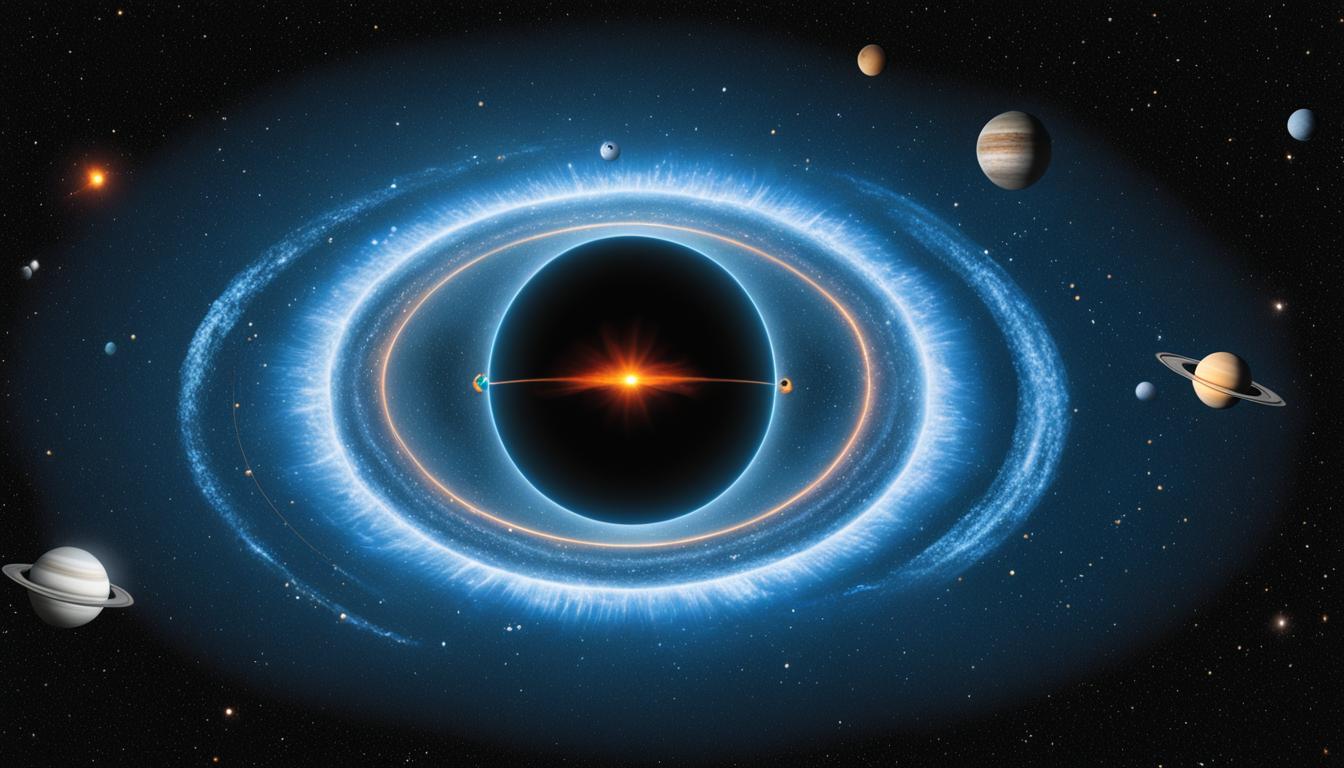
Get ready for an amazing journey through our vast universe. We’ll share 10 incredible facts that will make you curious and appreciate the beauty of space. You’ll learn about the universe’s huge size and the mysteries of black holes. These facts will show you how amazing and complex space is.
Our universe is full of amazing things that are hard to understand. Let’s dive into the vastness of the universe. We’ll explore the mysteries of black holes and the secrets of celestial discoveries. Get ready to be amazed by the wonders that are out there.
The Vastness of the Universe
The universe is huge and amazing, stretching far beyond what we can imagine. It’s thought to have over 100 billion galaxies, each filled with billions of stars. Looking at the cosmic scale of this vast space is humbling. The galactic dimensions and astronomical distances are beyond what we usually think about.
Exploring the Infinite Expanse
Proxima Centauri, the closest star to us, is over 4 light-years away. This distance is so huge, it’s hard to understand. If you could travel at the speed of light, it would take over 4 years to get there. The universe’s scale is amazing, showing us the vast, unexplored areas out there.
Mind-Boggling Distances and Scales
Trying to picture the astronomical distances in space is humbling. The Milky Way galaxy, our home, stretches about 100,000 light-years wide. Light would need 100,000 years to cross it. And the Milky Way is just one of many galaxies in the cosmic scale of the universe. Understanding the size of these galactic dimensions shows us how big the universe is.
Fun Facts About Our Cosmic Neighborhood
Our solar system is a small part of the vast universe, yet it’s full of fascinating facts. Exploring our celestial neighbors helps us appreciate the planets and moons that shape our universe.
Did you know Saturn’s rings are made of billions of ice and rock pieces? Or that Uranus spins on its side, causing unique seasons? These facts show how diverse and captivating our solar system is.
The distances in our solar system are huge. Earth is just 93 million miles from the Sun, but it’s tiny compared to the vastness of space. It takes years for spacecraft to reach the outer planets, showing how big our universe is.
Exploring our solar system reveals its beauty and complexity. From Mars’ tall mountains to Jupiter’s stunning auroras, there’s always something new to learn. These discoveries highlight the wonders of our cosmic neighborhood.
Celestial Wonders and Phenomena
The universe is full of breathtaking beauty, with cosmic spectacles that amaze us. From the stunning Northern Lights to the amazing meteor showers, the skies are always changing. These events can change how we see the world, showing us the dynamic nature of the cosmos.
Mesmerizing Astronomical Events
Meteor showers are one of the most captivating sights in the sky. They happen when Earth goes through a comet’s debris field. This lets us see tiny particles burning up in our atmosphere. Events like the Perseids and the Geminids are highly awaited, offering a stunning display of nature’s beauty.

The Northern Lights, or Aurora Borealis, are another amazing event. They are colorful lights in the night sky caused by the Sun’s charged particles and Earth’s magnetic field. Seeing these shimmering curtains of green, pink, and purple reminds us of our planet’s beauty and power.
Mysteries of Black Holes Unveiled
Black holes are mysterious objects in space that intrigue scientists. They have such strong gravity that not even light can escape. These areas show us how our universe works and how it changes over time.
Black holes change spacetime and help create new galaxies. As scientists learn more about them, they find new theories about the universe’s past and future.
Unraveling the Enigmas of Spacetime
At the center of a black hole is a point called a gravitational singularity. Here, physics as we know it ends. Scientists are trying to understand this mystery to learn more about spacetime.
Black holes bend spacetime in amazing ways. When matter and energy fall into a black hole, spacetime gets twisted. This makes scientists study black holes more to understand the universe’s secrets.
Scientists are also looking at how black holes affect galaxies. Supermassive black holes at galaxy centers help shape the stars around them. This connection between black holes and galaxies is another mystery scientists want to solve.
The Birth and Life of Stars
Stars are like bright lights in the sky, each with its own story. They start from gas and dust clouds and end in big explosions called supernovas. This journey from start to finish is called stellar evolution.
The story begins with gas and helium clouds collapsing under gravity. This makes the center hot and starts nuclear fusion, creating a new star. This process is key to our universe’s changing nature.
Stars change a lot as they live. They start fusing hydrogen, then go through many stages. Each stage shows how complex stars are, from the main sequence to the end in a supernova.
Studying stars helps us understand the universe better. Stars are important for making planets and recycling elements. By learning about stellar evolution, we see how our universe is always changing.
Exoplanets: Worlds Beyond Our Solar System
In the vast universe, there are countless worlds beyond our solar system, known as exoplanets. These planets orbit stars other than our Sun. They show us the diversity of planetary systems. From hot Jupiters to icy worlds, exploring exoplanets has shown us a wide range of alien landscapes.
This has sparked our curiosity about life beyond Earth and the origins of our planet.
Unveiling Alien Landscapes
Thanks to new telescope technology and methods, astronomers can now find and study more exoplanets. These discoveries show us a wide variety of planets, each unique and possibly hosting alien life. We see everything from hot Jupiters with huge storms to icy worlds that might support life.
Studying these distant planets helps us understand how planets form and change over time. This could lead to finding worlds that can support life. It makes us dream of discovering life elsewhere and broadens our view of the universe.
Dark Matter and Dark Energy Conundrums
The universe is full of mysteries, and dark matter and dark energy are two big ones. These forces make up most of our universe but are hard to see and understand. Scientists and fans of the stars are all trying to figure them out.
Dark matter is a type of matter we can’t see because it doesn’t reflect or absorb light. But we know it’s there because of how it affects galaxies and galaxy clusters. It’s thought to be about 85% of all matter in the universe. Finding out what dark matter is could change how we see the universe.
Dark energy is even more mysterious. It’s what makes the universe expand faster and faster, pushing galaxies apart. It’s a big part of the universe, about 68%, but we don’t know much about it. Scientists are still trying to understand where it comes from and what it does.
Finding out about dark matter and dark energy is important for understanding the universe. These forces could help us learn more about how our universe began and how it will end. The discoveries could change how we see the world.
The Cosmic Microwave Background Radiation
The cosmic microwave background radiation (CMB) is a key piece of evidence for the Big Bang theory. It’s a faint glow that shows us what the early universe looked like. Scientists have mapped this radiation with great precision, finding tiny changes that help us understand how the first galaxies formed.
Echoes of the Big Bang
The cosmic microwave background radiation proves our universe’s amazing origin and growth. It’s a faint glow that fills the whole universe and matches the Big Bang theory well. By looking at the small changes in this radiation, scientists learn about the early universe, just after the Big Bang.
This radiation acts like a cosmic fingerprint, keeping the universe’s early state. The tiny temperature changes in it, seen in detail by the Planck satellite, show where the first structures came from. These changes were from early density differences that gravity made into the big structures we see today.
In 1964, Arno Penzias and Robert Wilson found the cosmic microwave background radiation. This was a big moment in astrophysics. It proved the Big Bang theory and started a new era of studying the early universe. The CMB is still a key tool for understanding our universe’s beginning, growth, and basic nature.
Fun Facts About Space Exploration
The history of space exploration is a journey full of amazing achievements and hidden facts. It shows how humans keep pushing to explore the unknown. From the first Moon landing to the tech behind today’s spacecraft, it’s a story of human creativity, hard work, and a deep desire to learn.

The Apollo 11 mission in 1969 was a key moment in space history. Neil Armstrong and Buzz Aldrin were the first humans to walk on the Moon. But did you know their boots are still on the Moon? They won’t be worn away by wind or weather because there is none on the Moon.
Space exploration has also led to amazing tech breakthroughs. The Hubble Space Telescope has changed how we see the universe. It gives us beautiful pictures and important data. The Mars Curiosity Rover has been on Mars since 2012, finding out more about the planet’s geology and if it could support life.
Looking ahead, the future of space travel is full of possibilities. We’re working on reusable rockets and might even have people on Mars soon. The next steps in space exploration will surely be as exciting as the ones before.
The Future of Space Endeavors
Looking up at the stars, we see a bright future for space exploration. NASA and SpaceX are leading the way with plans for missions to Mars. They aim to push human spaceflight and tech to new heights.
They’re working on new ways to move through space and even space tourism. These innovations will change the future in big ways.
Space colonization is now a real goal, not just in movies. We’re planning to live on the Moon and Mars. These places will be testing grounds for new tech, like clean energy and life support systems.
The future of space is full of mysteries waiting to be solved. We’ll explore planets outside our solar system and reach the farthest corners of our own. This next chapter will bring huge discoveries and new tech breakthroughs.